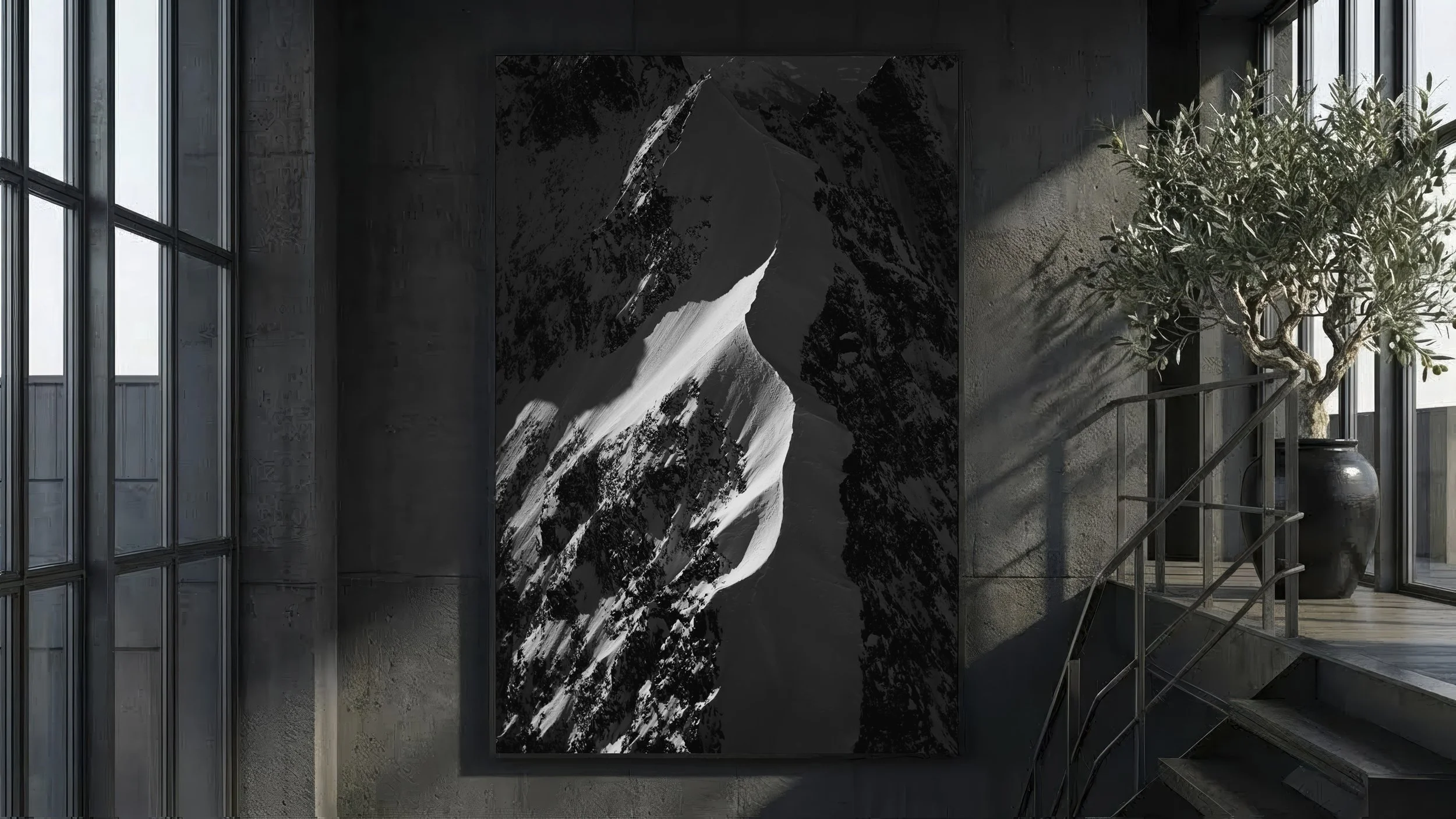
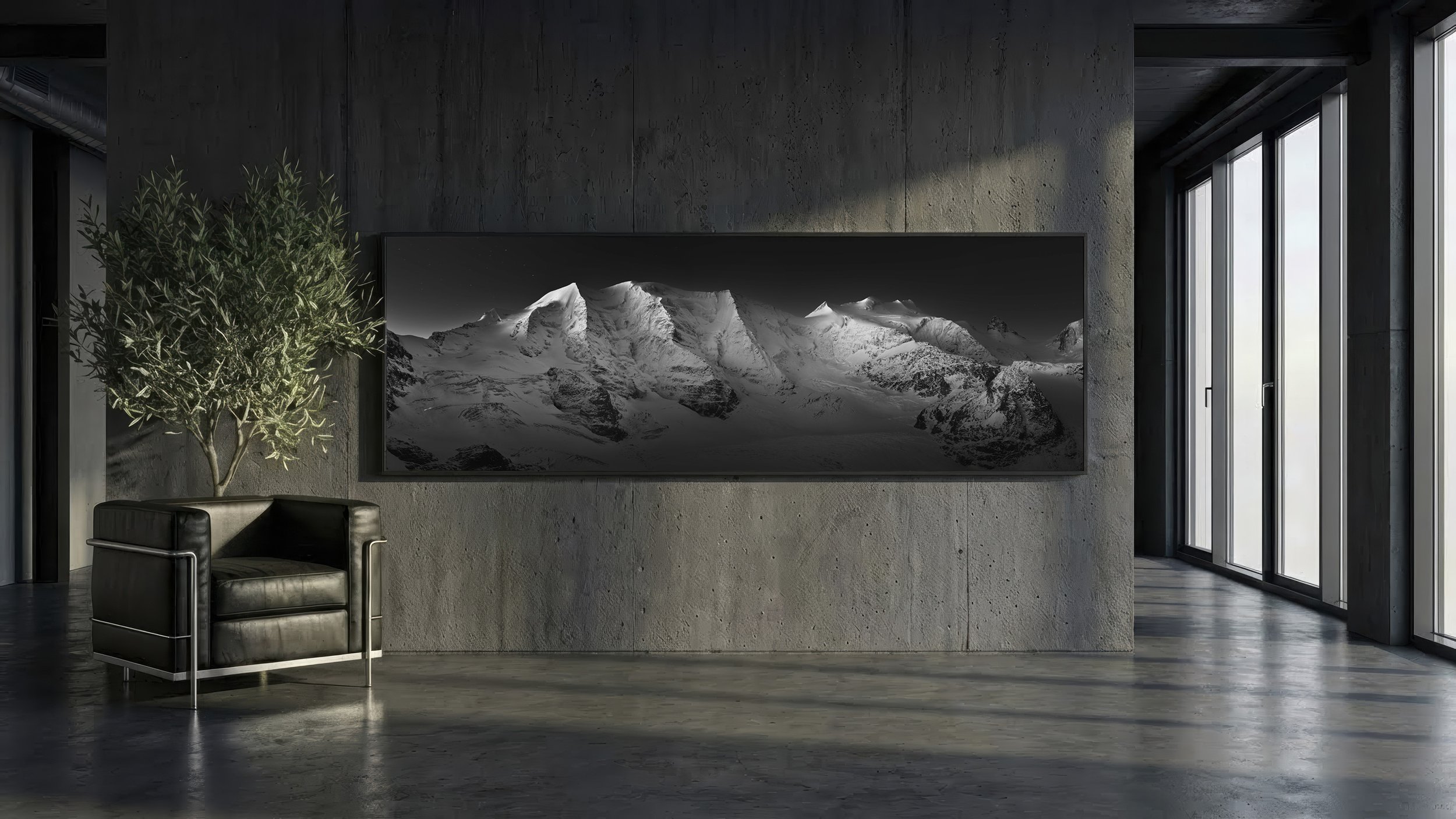
6:23am The Moment of truth at 3000 meter.
Cold. Patience. Perfection. The Story Behind an Image.
Piz Palü and Biancograt. Seen a thousand times, photographed a thousand times. Every angle is familiar, by day and by night. But familiarity is not enough when the extraordinary is required. Decision made: One more night up there. Alone. A new work emerged. One of my best images to date.
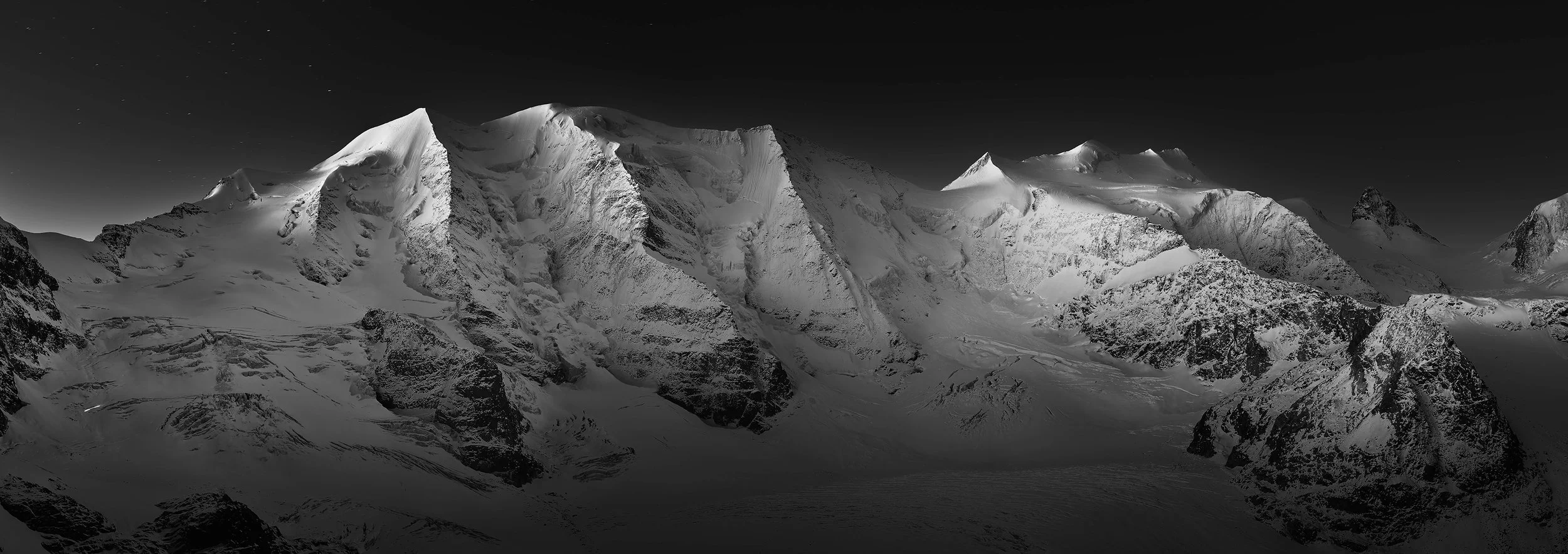
Sunrise on Piz Palü © Jürg Kaufmann
The Weight of an Empty Wall
It all began with a message a few months ago. An art collector had seen the 24-meter Piz Badile work at the Grace La Margna Hotel in St. Moritz. His vision for his home in the Rhine Valley: an over four-meter Piz Palü at sunrise and a four-meter-high Biancograt. A house designed down to the last detail. Nothing left to chance.
Gratitude mixed with respect. I felt two things simultaneously — pride at being invited into a project of this calibre, and the full weight of responsibility that comes with it. At this scale, the artwork must belong to the wall, to the room, to the house. Walls are never perfectly square. Millimetres become centimetres at 450 cm. I went back with measuring equipment to document every detail — wall surfaces, light angles, mounting positions. Good thing we did.
The Production Challenge
The dimensions exceeded every standard for fine art prints. My first thought was Diasec — the face-mounted acrylic process that photographers like Andreas Gursky use for their largest works. Technically perfect. Museum standard. But at 450 centimetres, we hit a problem that was nearly impossible to solve: there is only one facility in Europe capable of producing Diasec fine art prints at this scale, and it is not in Switzerland.
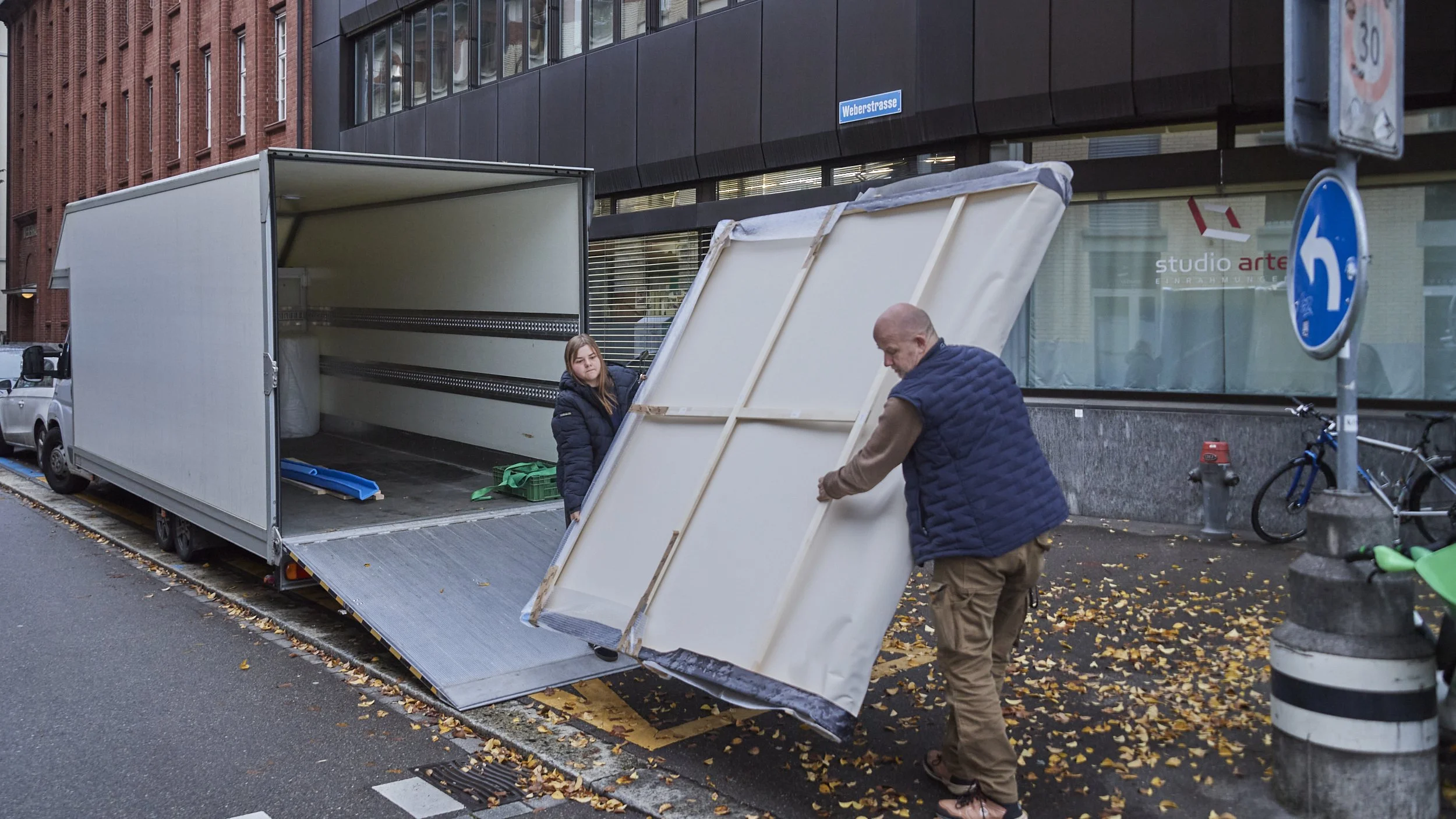
Then came the question nobody thinks about until they have to. How do you transport a 4.5-metre artwork by truck from northern Germany to Switzerland? How does it clear customs intact? How does the framer work with it? And ultimately — how does it enter the house? Trust me: customs is the small challenge. The logistics and safe handling are a project in themselves.
I stepped back and reconsidered. Sometimes the best solution is not the most obvious one.
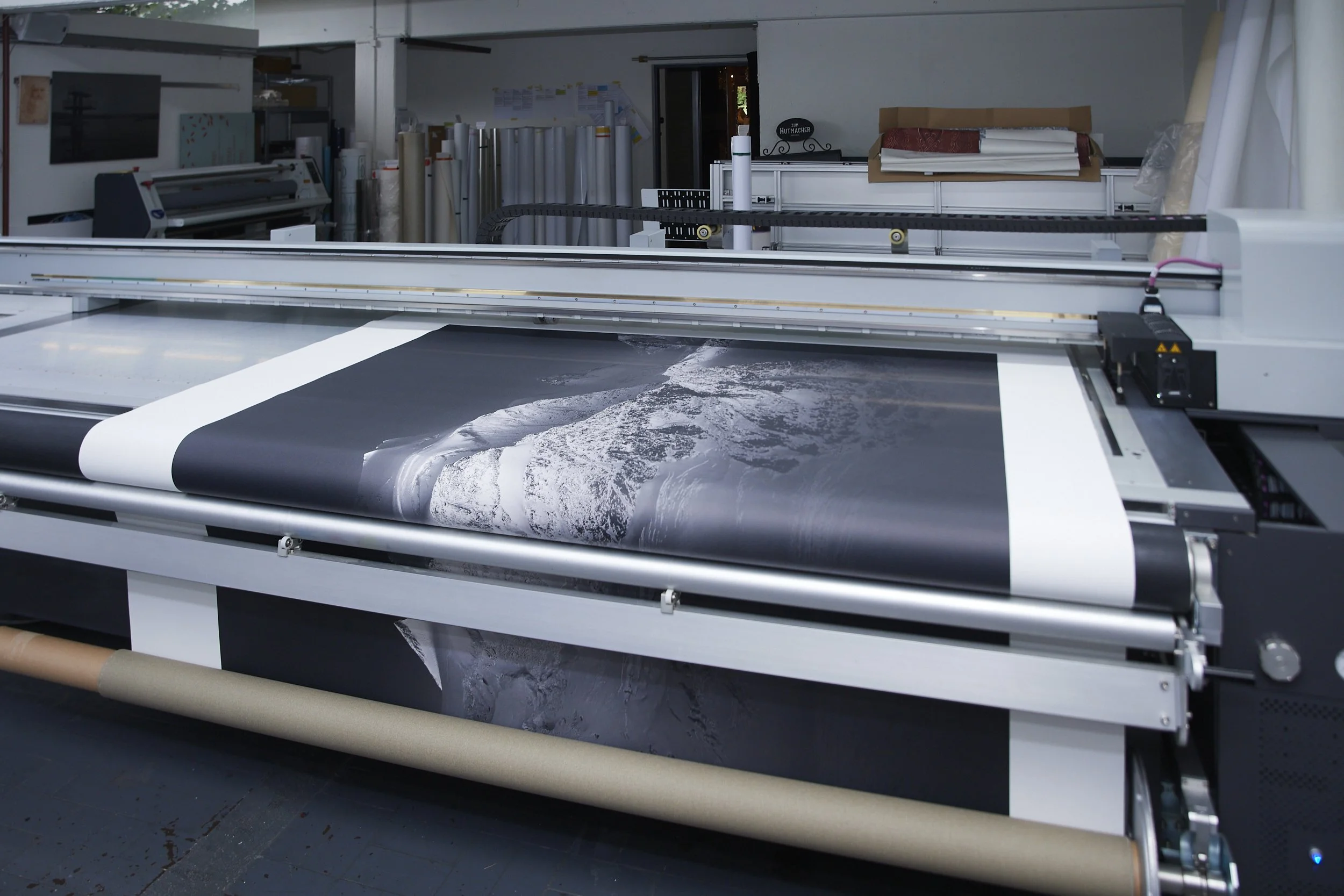
Together with a partner in Switzerland, a roll of the finest canvas was tested to the limit. Real colour pigments on premium white canvas. After metres of test prints, the foundation was right. The impossible logistics chain from northern Germany disappeared. The quality spoke for itself.
The Photograph That Did Not Yet Exist
Printing the Biancograt was a beautiful experience. But with the Piz Palü, something was missing. I checked my existing image data at 450-centimetre scale and realised: the resolution was not enough. Not at this size. Not for a print where every rock face and every ridge line must hold at arm's length. The data was excellent for standard large format at 2.5 metres, but monumental scale is unforgiving.
I felt like I was standing in front of a deep crevasse. The client loved this composition — Piz Palü with Bellavista in early morning light. We had discussed it, refined the crop, imagined it on the wall. And now I had to solve a problem I could not solve from my desk. I had to find a way across that crevasse.
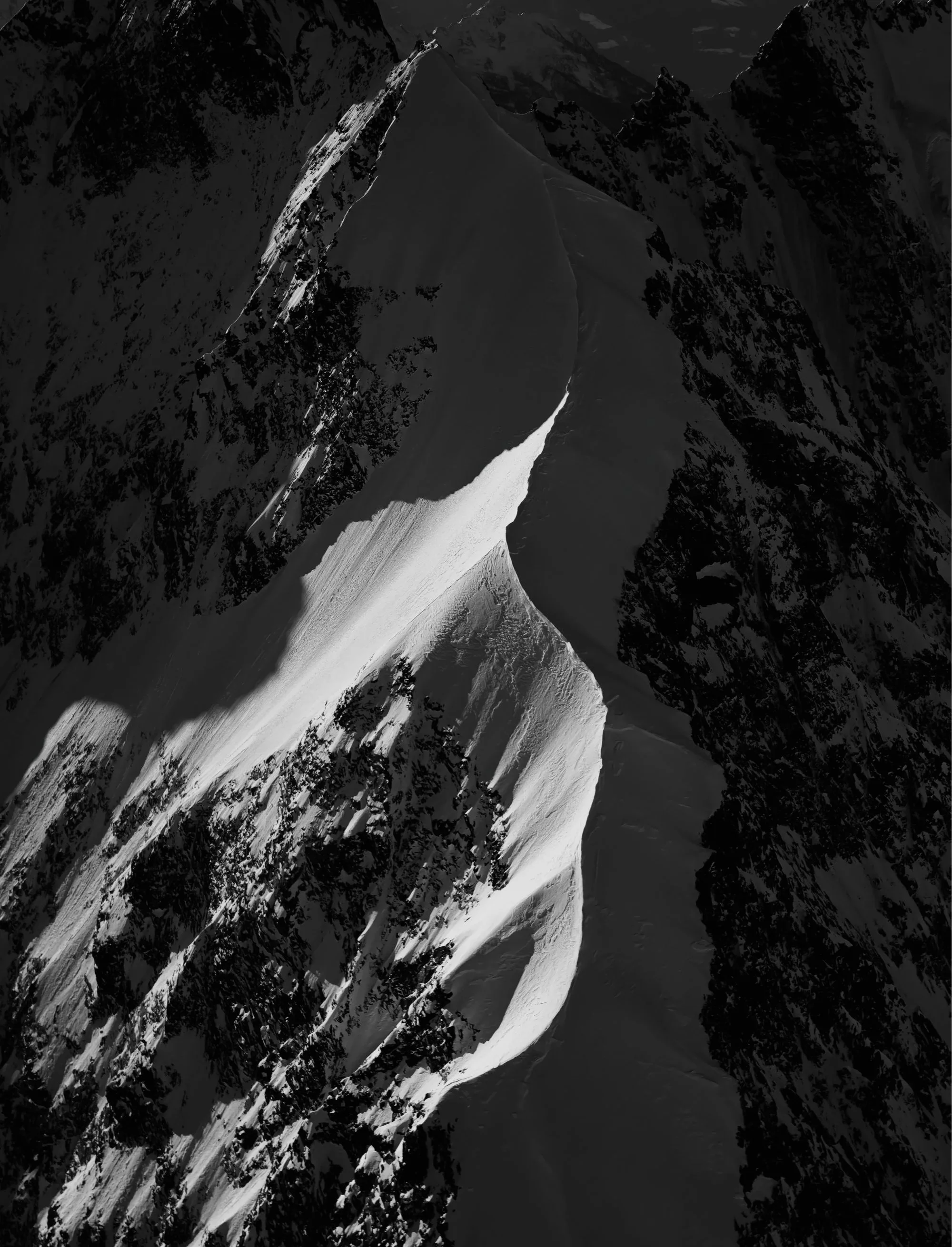
Sunrise on Biancograt with Pizzo Bianco © Jürg Kaufmann
From Saint-Tropez to the Diavolezza
I was in Saint-Tropez at the time, photographing classic yachts for the Gstaad Yacht Club. Mediterranean light, warm evenings, the quiet rhythm of the harbour after the regatta.
Then I checked the glaciers.today images. The first snow had hit the Engadin. And there was a full moon.
I know these mountains. I have photographed Piz Palü, the Pers Glacier, and the Bernina massif in every season, at every hour, in every condition. I knew exactly what this combination meant — fresh snow, clear skies, full moon, and the chance for that one brief moment when the last moonlight meets the first sunlight scattered through the atmosphere.
I made a decision. Perhaps somewhat impulsive. I call it commitment.
I left Saint-Tropez. Drove home. Packed my mountain gear and cameras. Drove to the Diavolezza.
3'000 Metres, 1 AM
From sea level to 3'000 metres. At one in the morning, I stepped outside. No clouds. Stars so dense they seemed to hum. The cold was brutal — a cold that finds every gap in your clothing, that freezes your own breath as ice on the lens hood.
I climbed to my position and waited.
By four in the morning I had exposures. Good ones. But I was not satisfied. The moonlight alone was not enough. I knew what I was waiting for — that one moment when the rising sun, still below the horizon, begins to scatter light through the atmosphere. A diffuse glow meeting the hard light of the moon. It lasts only minutes.
6:23 AM. The moment had come. The first sunrays grazed the white peaks. Piz Palü and Bellavista stood in that impossible balance between night and day, between moon and sun. Eight high-resolution vertical images. One after the other. After hours of waiting, everything had to happen fast. The moment was magical, concentration total. Fingers stiff. Nose tip frozen. But I had the image.
07:30 — A Surprise
Back at the mountain hut of the Diavolezza, after six hours at 3'000 metres, came the moment of truth on the screen. The panorama was complete. A resolution that eclipsed everything that came before.
At 07:30 I sent the client a WhatsApp: I have a surprise for you.
He replied in under a minute. He had no idea I had spent the night in the high mountains, waiting for a moment that might never have come.
Surprised and happy, he invited me for a drink at his house on my way back from the Engadin.
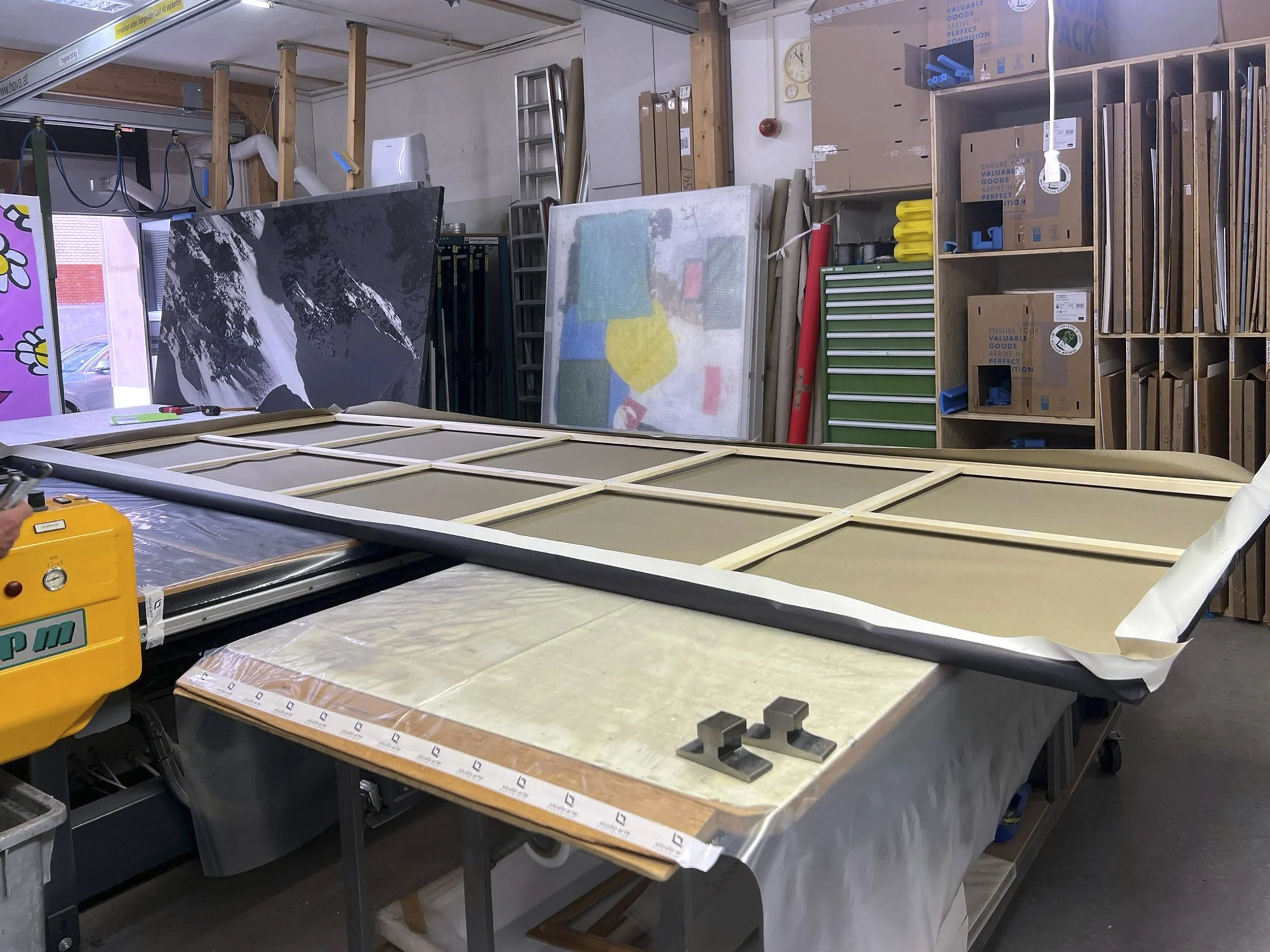
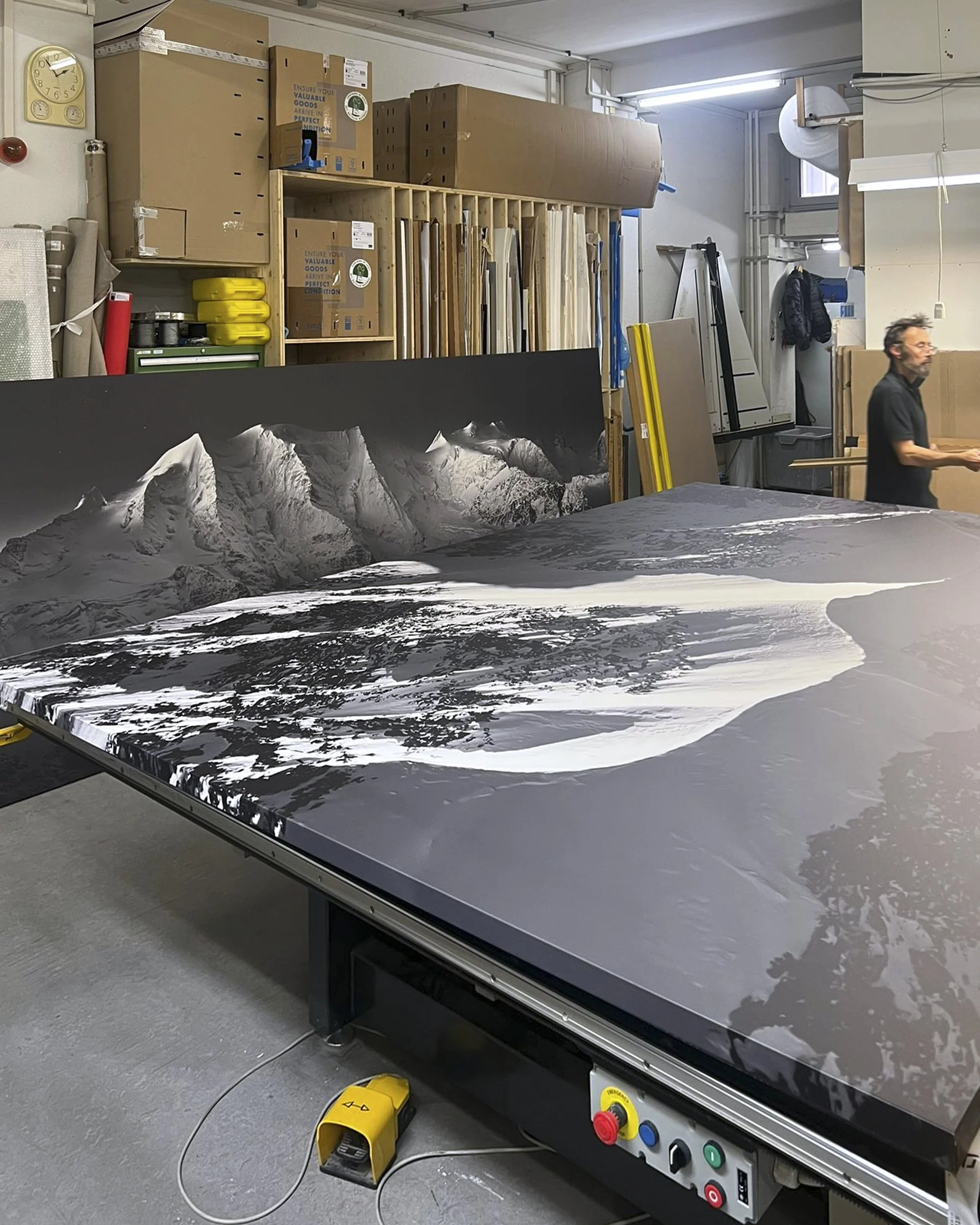
From Data to Wall
Two days at the monitor followed. Assembling the eight images, digital craftsmanship to perfection. Every detail had to hold. Every tonal transition had to be seamless across 450 centimetres.
During printing, it became clear: every minute in the cold and at the monitor was worth it. The works were finished by a specialist. Mounted and framed in black oak — matched exactly to the colour tone of the house.
Seeing these giants come to life in the workshop was moving. The moment was almost too short before they were packed for transport.
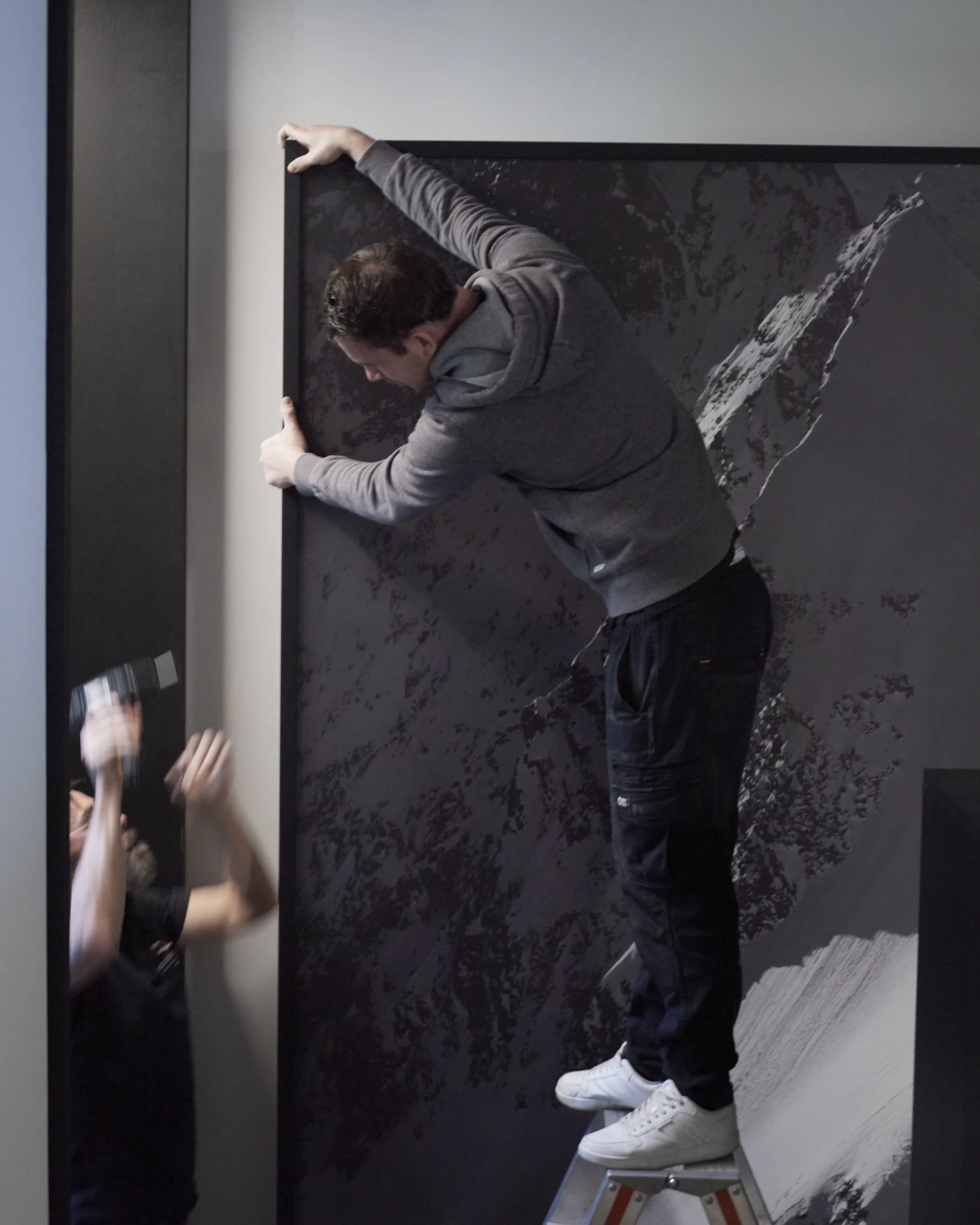
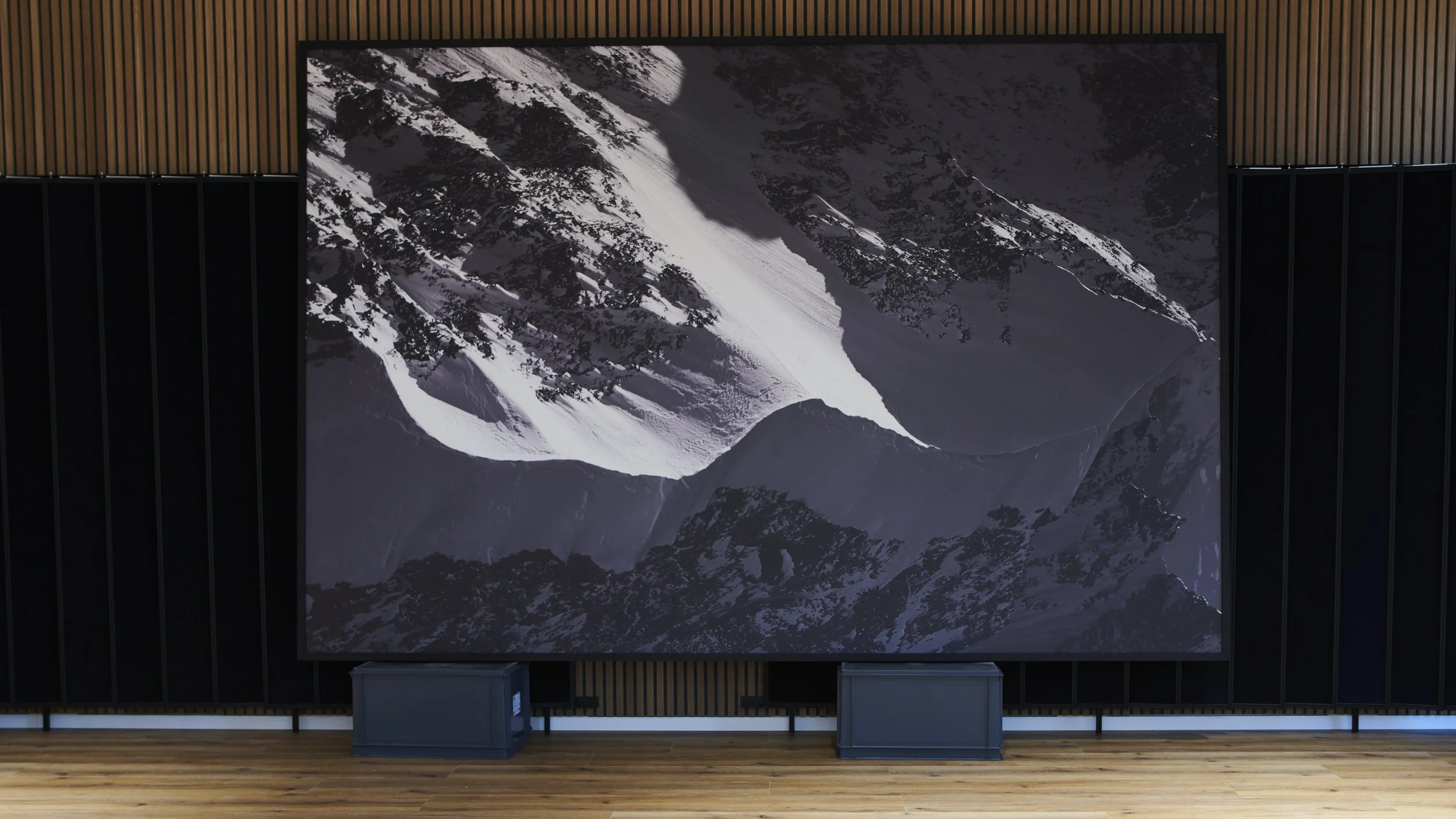
nstallation on site: pure tension. Everyone was focused. And suddenly, the Biancograt hangs on the wall. Sat down on the stairs and simply enjoyed the moment.
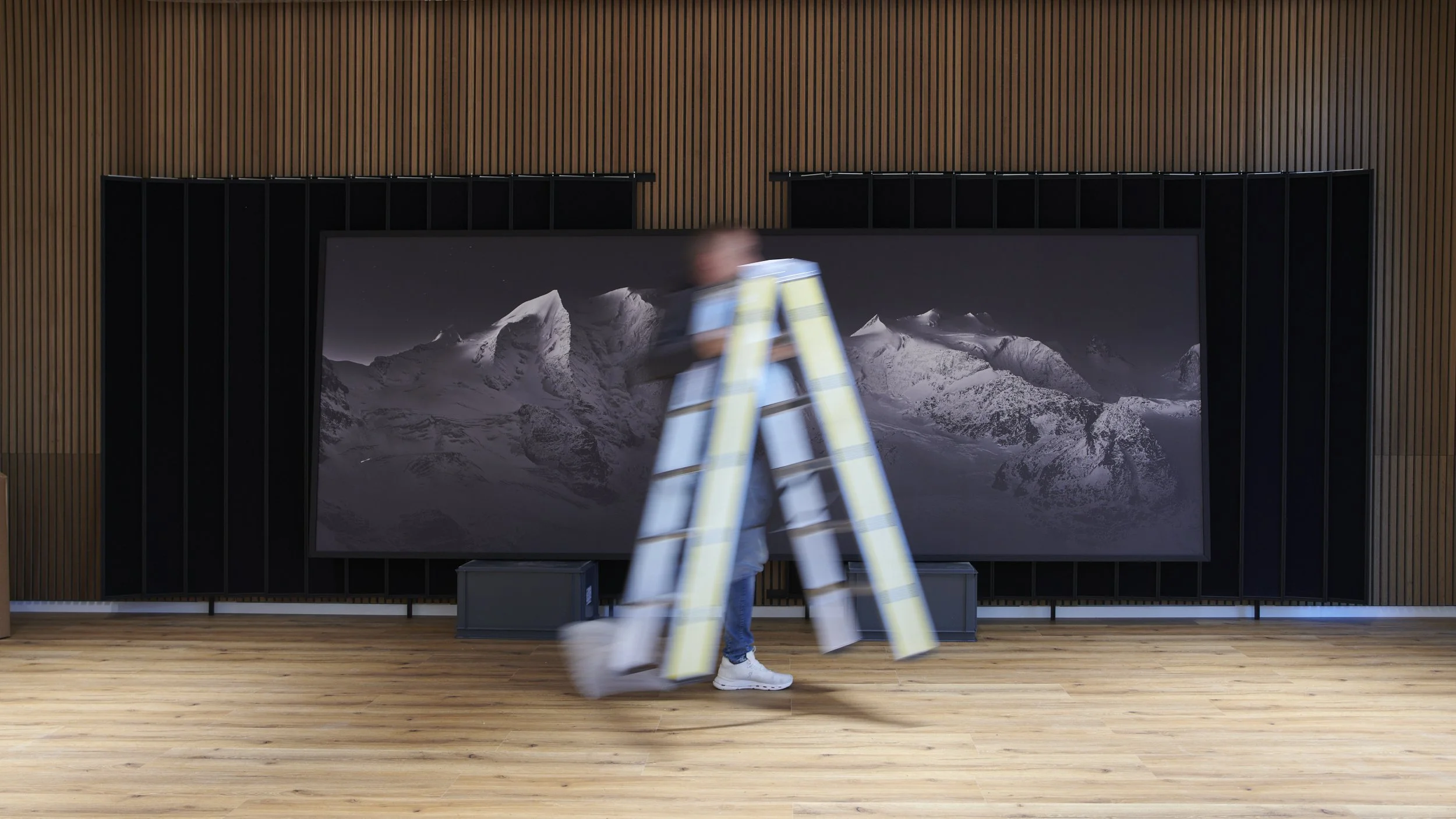
The moment both works hung in their rooms — the vertical Biancograt commanding one wall, the horizontal Piz Palü filling the other with that subtle morning light — the entire project made sense. Every cold hour, every logistical puzzle, every test print, every return visit to measure a wall that was not quite square.
The photographs belonged there. As if they had always been waiting for that house.
The Extra Mile
The client opened a bottle of white wine. Jürg, I have something for you. He handed me a stone and asked: Do you know where this is from? I recognised the rock from the Palü and Piz Bernina. He smiled: Just a bit further away. And higher. Exactly — Jann, the client, had been to the summit of Mount Everest and brought back a stone.
I was close to tears. Thank you, Jann.
The stone sits on my desk now. It reminds me every day that it makes sense to go the extra mile.
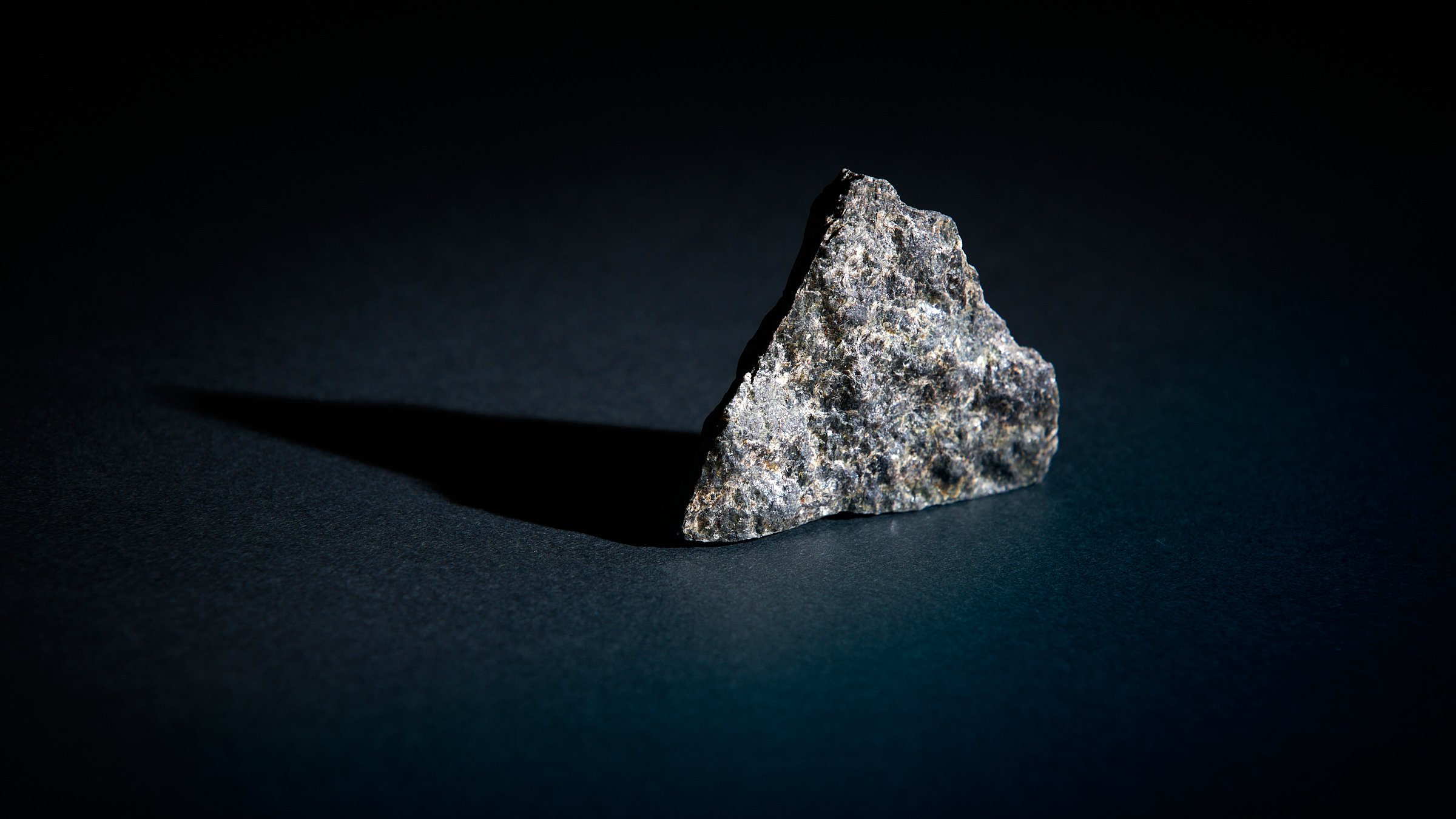
A piece of Mount Everest on my desk
Note: AI visualisation used for privacy reasons.
Thanks to everyone for this great collaboration. True teamwork from the first idea to the moment the image found its new home.
Partner in this project: Bost Productions & Studio Arte
Jürg
Biancograt & Piz Palü.
Note: AI visualization used for privacy reasons.